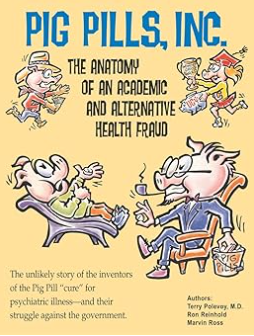
Read the full story: Pig Pills, Inc.
The definitive exposé of EMPowerplus, the Synergy Group, and Truehope — by Dr. Terry Polevoy, Marvin Ross, and Ron Reinhold.
Get it on Kindle →A rebuttal built for a clinical audience
A little over a year after Pig Pills, Inc. was published, Terry and Marvin drove to London, Ontario to present "Alternative Medicine and Your Practice" to the psychiatric residents and staff who would eventually be treating the very patients Truehope's promoters were targeting. Where the recorded pitch at St. Joseph's Hospital in Hamilton captures Truehope's sales pitch from the inside, this presentation is the documentary rebuttal — dense with dates, named researchers, and records obtained through Freedom of Information requests, aimed at equipping the next generation of psychiatrists to recognize the pattern before it reached their own patients.
Approved before it existed
The single sharpest piece of documentation in the talk is a dated sequence showing that EMPowerplus's clinical trials were approved before the product — or the company that made it — existed.
Institutional review board approval, in other words, was granted before the company that made the drug existed.
The researcher's own data, against her own conclusions
Terry and Marvin walked the room through Dr. Bonnie Kaplan's published data against her own stated conclusions. Her presentation to the Canadian Psychiatric Association in 2000 concluded that the supplement had, in most cases, "entirely replaced psychoactive medications" — yet her own Table 3 showed only one of eight medicated subjects had actually come off medication by the study's end. Her subsequent Journal of Clinical Psychiatry publication showed a similar gap: three of twelve medicated subjects off medication, not "most."
An unpublicized, negative trial
A completed fibromyalgia RCT, presented at the American College of Rheumatology in 2002 and never publicized by Truehope, found no benefit whatsoever from EMPowerplus against placebo in ninety-nine patients — thirty-four of whom dropped out due to side effects. When Marvin asked the university how many of the thirty-four withdrew from the placebo arm versus the active treatment arm, they refused to say.
What was actually in the pills
Independent lab analysis by the Schizophrenia Society of Ontario — conducted in Denver, after a first attempt was rejected because Marvin had opened his undercover-purchased bottle before submitting it, breaking the chain of evidence — found that of thirty-six listed ingredients, only twenty-three could even be measured. Sixteen of those varied by as much as seventy percent from the label. Nine exceeded upper tolerable limits for toxicity, including vitamin A at outright toxic levels in the very bottle presented at the talk.
The original manufacturing lab was not an FDA-approved pharmaceutical facility — its parent company's best-known product was ice cream flavourings.
Dr. Catherine J. Field"I have never analyzed the content of the product beyond the information on the label" — despite being the researcher credited with evaluating it for the Alberta-approved study.
The Utah admission
The U.S. Office for Human Research Protections found in August 2002 that the Utah phase of the research had been conducted despite a prior ethics board rejection. The recording of the talk adds something sharper: in a direct interview, the Utah-based psychiatrist running that phase of the study told Marvin his research proposal had been rejected by Utah's own ethics board four or five times — before he simply folded his patients into Bonnie Kaplan's Calgary trial instead.
Calling Truehope's own call centre
To close the clinical portion of the talk, Terry and Marvin played recordings of calls made to Truehope's own call centre — volunteers working from ten realistic scenarios, designed by an anonymous GP and vetted by a senior psychiatrist for authenticity, posing as prospective patients.
"These people are very happily answering phones, dispensing medical advice," Marvin told the room.
The book
This presentation, and the recorded evidence behind it, is part of the documentary record behind Pig Pills, Inc., co-authored by Dr. Terry Polevoy, Marvin Ross, and Ron Reinhold — the definitive exposé of EMPowerplus, the Synergy Group, and the extraordinary claims made for a nutraceutical sold to bipolar patients in Canada and the U.S., over the objections of Health Canada.