Pus Is Not Viral
At the 2019 retrial, the defence convinced a judge that Ezekiel Stephan had "viral" meningitis and died of a lack of oxygen. The child's own autopsy, the doctors who treated him, and a century of pathology say otherwise.
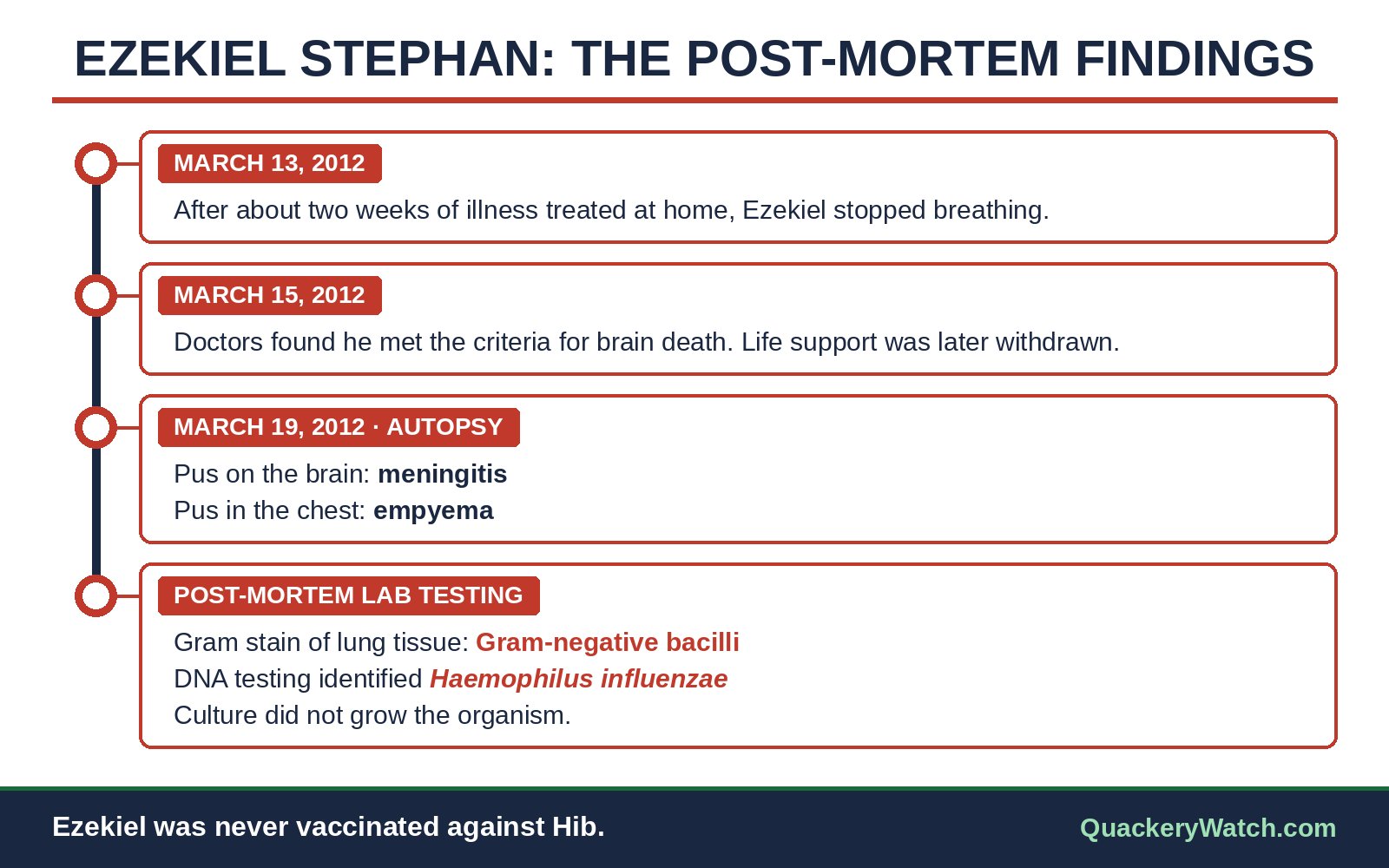
Ezekiel Stephan was 19 months old when he died in March 2012. He had never been vaccinated, including against Haemophilus influenzae type b (Hib). For about two weeks his parents, David and Collet Stephan of Glenwood, Alberta, treated his illness at home with natural remedies. They called 911 only after he stopped breathing. The background, and the Stephan family's ties to the Truehope supplement company, are on our main page, Ezekiel Stephan and Truehope.
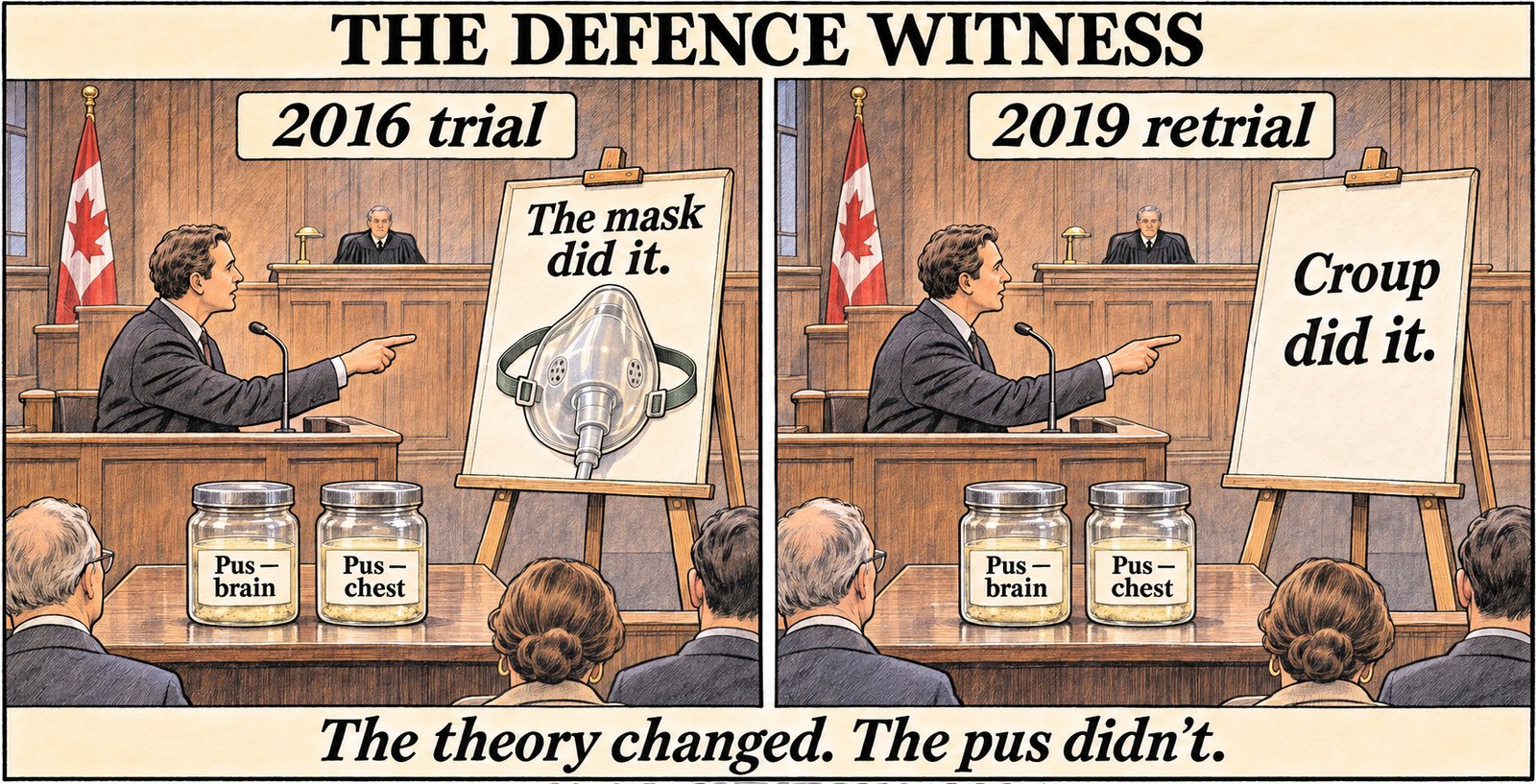
This page deals with a single medical claim. At the 2019 retrial in Lethbridge, Collet Stephan's lawyer, Shawn Buckley, told the court in his closing argument that bacterial meningitis could not have killed Ezekiel. He relied on the defence's pathology expert, Dr. Anny Sauvageau, Alberta's former Chief Medical Examiner. She had testified that Ezekiel more likely had viral meningitis, that it didn't affect his brain either way, and that he really died of hypoxia (oxygen deprivation).1 At the first trial in 2016 she had blamed an ambulance that lacked a child-sized mask.14 By 2019 her explanation had changed: she said viral croup (enterovirus laryngotracheobronchitis) had blocked his airway and stopped his breathing.39
The judge, Justice Terry Clackson, accepted that theory. In his reasons he concluded that Ezekiel's meningitis "was viral," and that he died "from the lack of oxygen," not from meningitis.2 He wrote that Ezekiel stopped breathing because of complications of croup.39
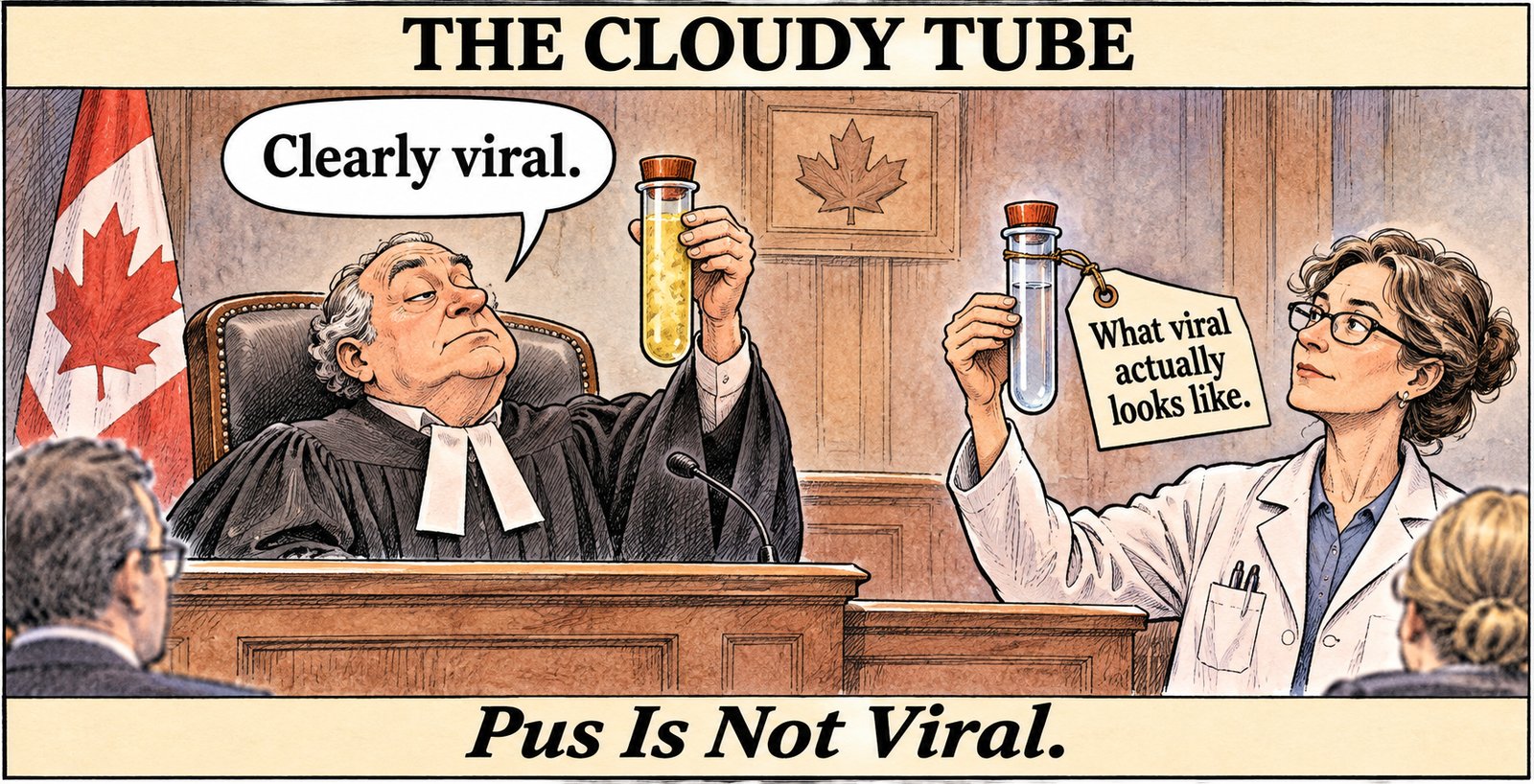
Any paediatrician who has treated meningitis knows this theory can't survive one fact that is on the record: there was pus.
The fact both pathologists agreed on
The case is often reported as a clash between two forensic pathologists, but on the central physical finding they agreed. Lethbridge News Now reported in August 2019 that Dr. Sauvageau and the autopsy pathologist, Dr. Bamidele Adeagbo, both accepted that there was pus in the brain. Their disagreement was over whether that pus meant bacterial or viral meningitis.3
Dr. Adeagbo performed the autopsy on 19 March 2012. He gave the cause of death as bacterial meningitis and empyema, a collection of pus in the chest cavity around the lung.4 He told the 2019 court that there had been "no confusion" about why the child died.5
So the defence had to explain two collections of pus in a dead toddler: one on the brain and one around a lung. Their explanation was a virus.
Why viral meningitis does not make pus
Meningitis is inflammation of the membranes covering the brain and spinal cord. Medicine has long divided acute meningitis into two broad types, and the names describe what the doctor or pathologist actually sees.
| Feature | Bacterial (pyogenic, "pus-forming") | Viral ("aseptic") |
|---|---|---|
| What covers the brain | A thick, creamy yellow-green purulent exudate made of neutrophils, fibrin and bacteria | Usually little or nothing visible. Mild swelling, scattered lymphocytes on microscopy |
| Spinal fluid | Cloudy or frankly purulent. Thousands of white cells, mostly neutrophils. Low glucose | Clear or slightly hazy. Modest numbers of mostly lymphocytes. Normal glucose |
| Untreated course | Rapidly progressive and, without treatment, fatal | Usually milder and self-limiting |
| Complications | Brain swelling, vasculitis, infarction, hydrocephalus, subdural effusions, seizures, deafness, death | Uncommon |
Sources: standard pathology teaching summarized from university course materials and textbooks.6,7
The word "aseptic" in aseptic meningitis literally means without pus. One medical-education summary puts it plainly: in viral meningitis the inflammation is milder and a purulent exudate does not form
, which is why it is called "aseptic."7 A university infectious-disease text describes acute bacterial meningitis as a severe illness with purulent CSF that is rapidly progressive and, without treatment, fatal
, whereas aseptic meningitis is milder and typically self-limited.6
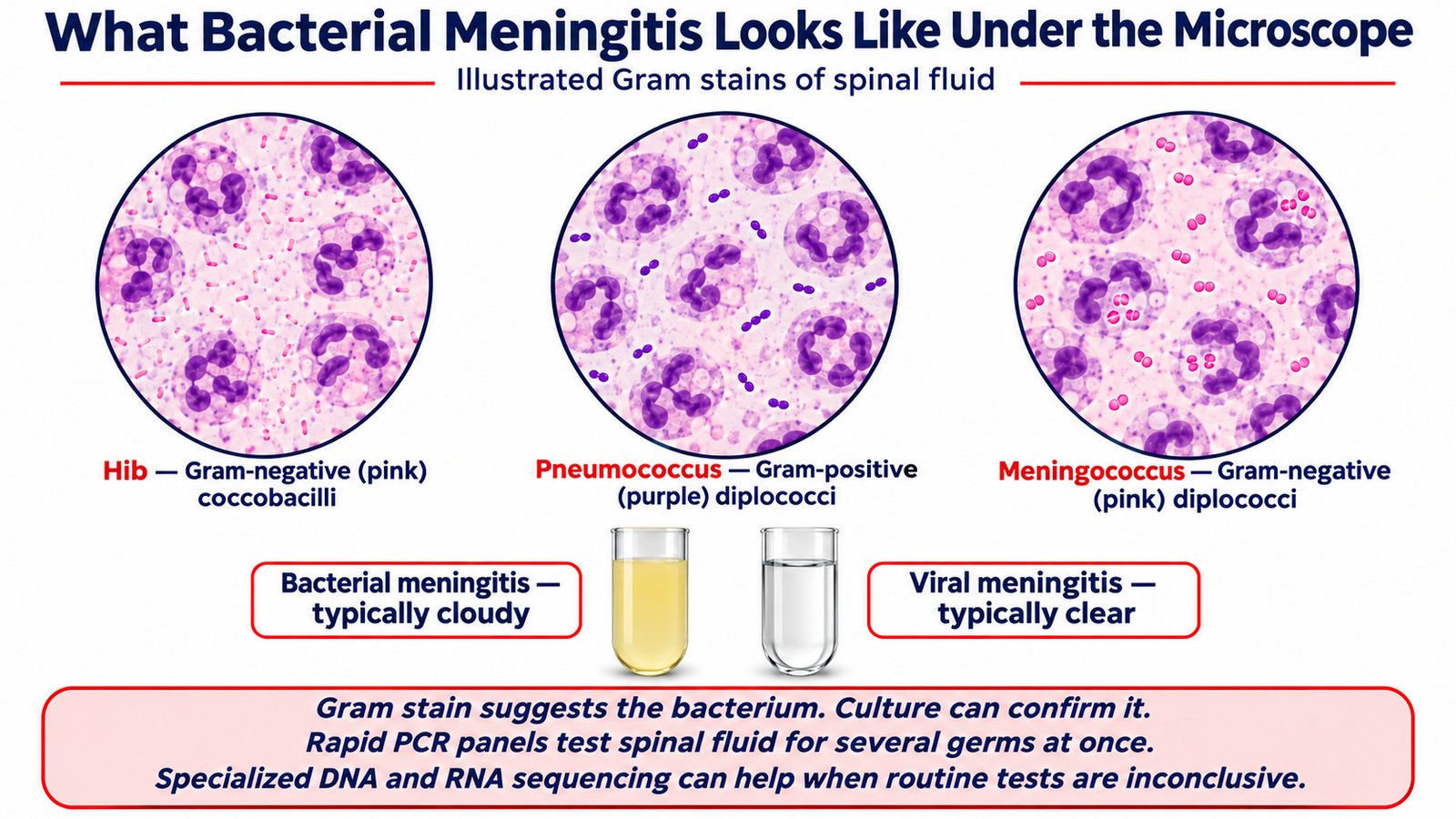
That is why the concession matters. Once the defence expert accepted that there was pus on Ezekiel's brain, she had accepted the defining physical sign of bacterial meningitis. Putting a viral label on it doesn't change what was found.
The empyema: a virus does not fill a chest with pus
The second finding gets less attention, but it is just as hard on the viral theory. An empyema is pus in the pleural space, the thin cavity between the lung and the chest wall. A viral pneumonia can leave a little clear fluid there. Frank pus means bacteria. It is a bacterial complication, usually of a bacterial pneumonia, and the standard treatment is antibiotics plus drainage.8
Paediatricians who trained before the Hib vaccine know this combination well. Purulent meningitis together with a pleural empyema in a child under two is a textbook presentation of invasive Haemophilus influenzae type b:
What the Hib literature shows
- Mexico, 1979. A series of 22 children with Hib pleural empyema found that every child was under 3 years old, with a mean age of 15.5 months. That is almost exactly Ezekiel's age. Nearly half also had purulent meningitis caused by the same organism.9
- Angola, 2003–2012. Finnish and Angolan researchers led by Dr. Heikki Peltola (Helsinki University Central Hospital), one of the world's leading Hib investigators, studied thousands of positive pleural-fluid and spinal-fluid samples from children. H. influenzae was found in 18% of empyemas and 26% of bacterial meningitis cases. Every one of the 55 strains that were serotyped was type b. After Hib vaccination began in 2006, Hib empyema fell by 83% and Hib meningitis by 86%.10
- United States, before the vaccine. CDC surveillance documents record that Hib was the leading cause of bacterial meningitis in children under 5. About 20,000 young children a year developed invasive Hib disease, roughly two-thirds of them before 18 months of age, and meningitis occurred in about two-thirds of invasive cases.11
Ezekiel was unvaccinated, 19 months old, and had pus on his brain and in his chest. That is the population and the pattern Hib vaccine was designed to prevent. Commentators who reviewed the case, including surgical oncologist Dr. David Gorski (Science-Based Medicine and Respectful Insolence), pointed out that the findings were consistent with Hib. Gorski reported that although the organism could not be cultured, PCR testing apparently detected Hib DNA.12 The judgment confirms that the DNA testing identified Haemophilus influenzae.39 David Stephan spent hours at the retrial attacking that test as a "research" test not approved for diagnosis.13 But the PCR result is only supporting evidence. The diagnosis doesn't depend on it, because the pus is already there.
The defence arguments, one by one
| Defence claim | What the evidence and the medicine show |
|---|---|
| "Ezekiel had viral, not bacterial, meningitis." | Viral meningitis is "aseptic": it doesn't produce a purulent exudate. Both pathologists agreed there was pus on the brain, and there was also pus in the chest. Dr. Sauvageau herself said she could not be certain it was viral, and she acknowledged that neither she nor Dr. Adeagbo is a microbiologist.3,14 |
| "There were lymphocytes, not neutrophils, so it wasn't bacterial." | She can't have it both ways: pus is, by definition, mostly neutrophils. The cell mix also changes over time. Standard teaching lists "partially treated bacterial" meningitis alongside viral infection as a cause of a lymphocytic picture.7,6 Ezekiel had been sick for about two weeks, and in hospital he was treated for both bacterial and viral meningitis before doctors found he met the criteria for brain death on 15 March.15,16 The autopsy followed on 19 March. Late, treated, post-mortem tissue is exactly where a textbook neutrophil picture would be least expected. |
| "Bacteria on unsterile instruments may have contaminated the autopsy." | Dr. Sauvageau raised the possibility that bacteria on the instruments got into the samples.3 Contamination can explain a stray positive culture or PCR signal. It can't put pus on a brain or fill a pleural space. Pus is the living body's inflammatory response to infection. A dead body doesn't make it on a steel tray. |
| "Croup stopped his breathing, and the lack of oxygen killed him." | Croup doesn't make pus on the brain or pus in the chest, and it doesn't account for a two-week illness. Dr. Sauvageau herself told the court that croup rarely stops a child's breathing and that its death rate is close to zero.39 Dr. Adeagbo testified that he tested the brain tissue and found no sign it had been deprived of oxygen.17 The paediatric intensivist who received Ezekiel in Calgary, Dr. Shauna Burkholder, attributed his brain swelling to meningitis. She said compression of the brain stem stopped his breathing, which then stopped his heart.18 In other words, the child stopped breathing because of the infection. Healthy toddlers do not stop breathing at home. |
| "Either way, the meningitis didn't kill him." | Dr. Burkholder called Ezekiel's CT scan one of the most abnormal she had ever seen.19 She told the court that untreated bacterial meningitis is fatal in every case, and that those who get medical help have a 95% survival rate.20 |
What the judgment itself says
Justice Clackson's written reasons (R v Stephan, 2019 ABQB 715) record evidence that points to bacteria, and then set it aside.39
- Gram-negative bacilli in the empyema. The judge noted that a sample of the right lung across the empyema was Gram-stained and showed Gram-negative bacilli, which he accepted was consistent with bacterial infection (para 47). Haemophilus influenzae is a Gram-negative coccobacillus.40 The stain matched the organism the DNA test identified.
- The DNA test named the organism. The judge recorded that Dr. Adeagbo identified Haemophilus influenzae as the bacterial agent (para 52). He set the DNA result aside because autopsies are not sterile and the sample could have been contaminated (para 49). That argument can explain a false DNA signal. It can't explain the pus or the Gram stain from inside the chest.
- "Hib is very rare." The judge treated Dr. Adeagbo's statement that Hib is now very rare as support for the viral theory (para 52). Hib is rare in Canada because nearly every child is vaccinated against it. Ezekiel wasn't.
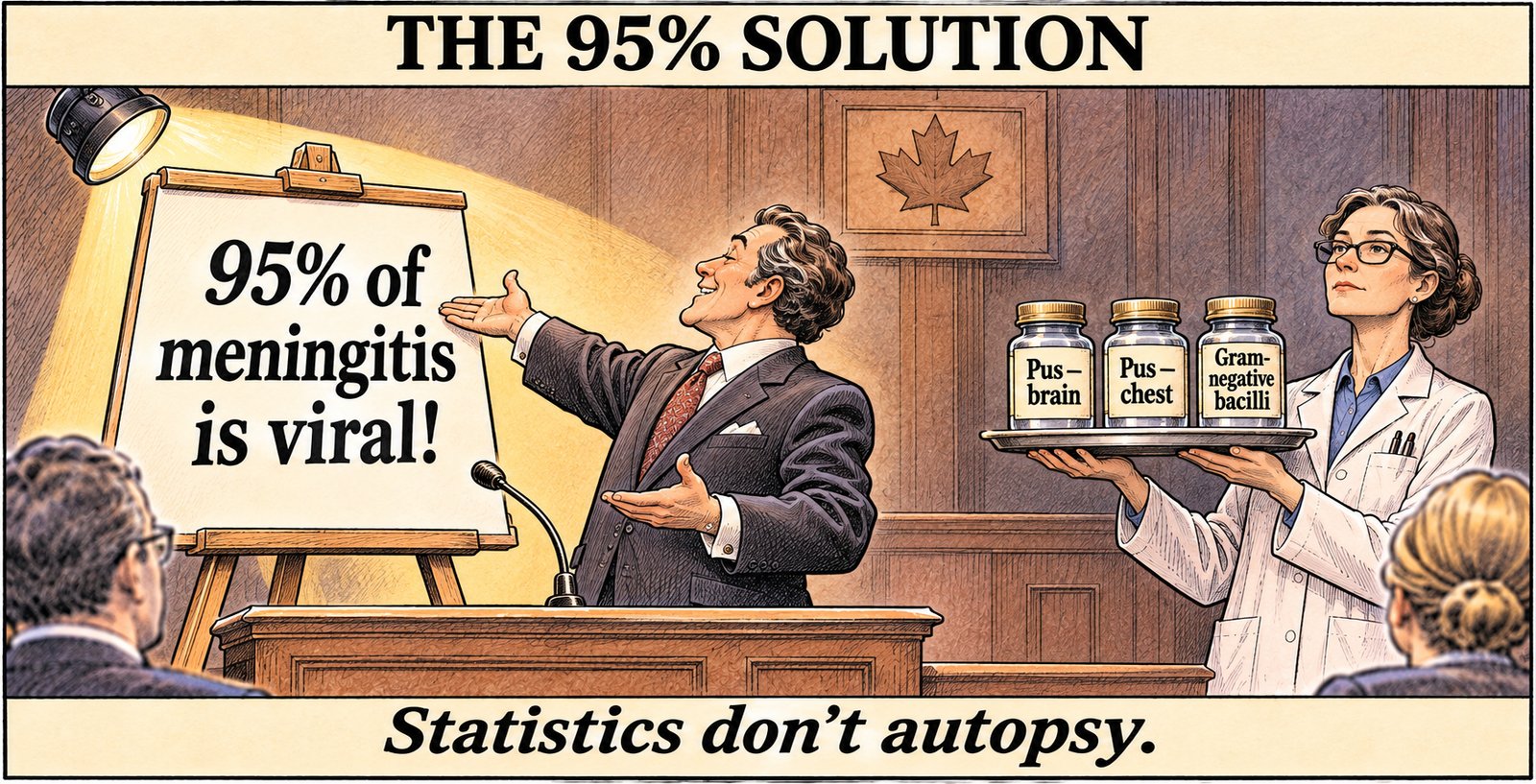
- "95% of meningitis is viral." The judge relied on Dr. Sauvageau's figure that 95% of children presenting with meningitis symptoms have a virus (paras 52, 62). That is a starting estimate for a child walking into an emergency department, before any tests. It stops being useful once a pathologist has found pus on the brain, pus in the chest and Gram-negative bacilli.
- Lymphocytes "exclude" bacteria. The judge accepted Dr. Sauvageau's view that the relative prominence of lymphocytes excludes bacteria. He also noted that her evidence on this point at the 2016 trial had been less certain (para 50). No textbook treats lymphocytes as excluding bacteria. Partially treated bacterial meningitis is a recognized cause of a lymphocytic picture.7
- An enterovirus in the nose. The judge faulted Dr. Adeagbo for ignoring enterovirus found on a nasal swab (para 48). Enteroviruses are among the commonest viruses children carry. A positive nasal swab shows that a virus was in the nose. It doesn't show the virus was in the brain, and it can't account for pus there.
- Treated for both. The judge accepted that Dr. Burkholder treated Ezekiel for both bacterial and viral meningitis (para 63).
The judge also wrote that many parents in the Stephans' position on 12 March "would have been perfectly justified in feeling their child needed medical attention" (para 103).39
Even "viral" would not have excused the delay
The viral theory mattered legally because the charge was failing to provide the necessaries of life. If the illness was "only" viral, the argument went, the parents had no reason to rush to a doctor. The witnesses who were actually there tell a different story.
- Terrie Meynders, a registered nurse and family friend, testified that she suggested the boy might have viral meningitis and told Collet Stephan he should see a doctor.21
- Naturopath Tracey Tannis told the court she instructed her assistant to tell the mother to take the child to emergency right away, because viral meningitis is deadly.22
- Collet Stephan had called that naturopathic clinic for an immune "boost," saying she thought her son might have meningitis, possibly viral.21 The family's own fear of meningitis was on record before he collapsed.
No physician tells parents that suspected meningitis of any kind can be managed with echinacea and a smoothie. Doctors can't tell viral from bacterial meningitis by looking at a child, which is why Dr. Burkholder treated Ezekiel for both. The lumbar puncture exists because only spinal fluid can tell the difference.
What Canada looked like before the vaccines
When I trained and practised in Canada between 1970 and 1977, three bacteria caused almost all the meningitis we saw in children: Hib, pneumococcus (which we still called Diplococcus pneumoniae) and meningococcus. All three were dangerous. The national figures show why a paediatrician of that era saw them every month.
| Organism | Before the vaccine | After the vaccine |
|---|---|---|
| Hib | About 1 in 200 Canadian children developed invasive Hib disease by age 5, an estimated 2,000 cases a year, a little more than half of them meningitis. Hib meningitis outnumbered all other reported bacterial causes combined.32 National reporting began only in 1979, when 220 Hib meningitis cases were reported. Reported invasive cases peaked at almost 900 in 1989.33 | About 26 reported cases a year nationally in 2008–2012.34 |
| Pneumococcus | Before the first conjugate vaccine program in 2002, invasive pneumococcal disease accounted for most severe invasive bacterial infections in Canadian children.35 In Alberta, the province where Ezekiel lived, the rate in children under 2 was 96.7 per 100,000 in 2000.36 | The Alberta rate fell to 25.8 per 100,000 by 2006.36 The share of pediatric pneumococcal meningitis caused by vaccine serotypes dropped from 85% to 26%.35 |
| Meningococcus | Endemic at roughly 0.4 to 2.0 cases per 100,000 a year from the end of the Second World War until 1985, with the highest rates in infants.37 | Between 0.45 and 0.75 per 100,000 a year since 2002, after conjugate meningococcal C programs began.38 |
Ezekiel Stephan was born in 2010 into a country where Hib meningitis had become so rare that most young doctors had never seen a case. His parents chose not to vaccinate him. He died of a disease that had killed and deafened Canadian children by the hundreds every year when I started practising.
From my own wards
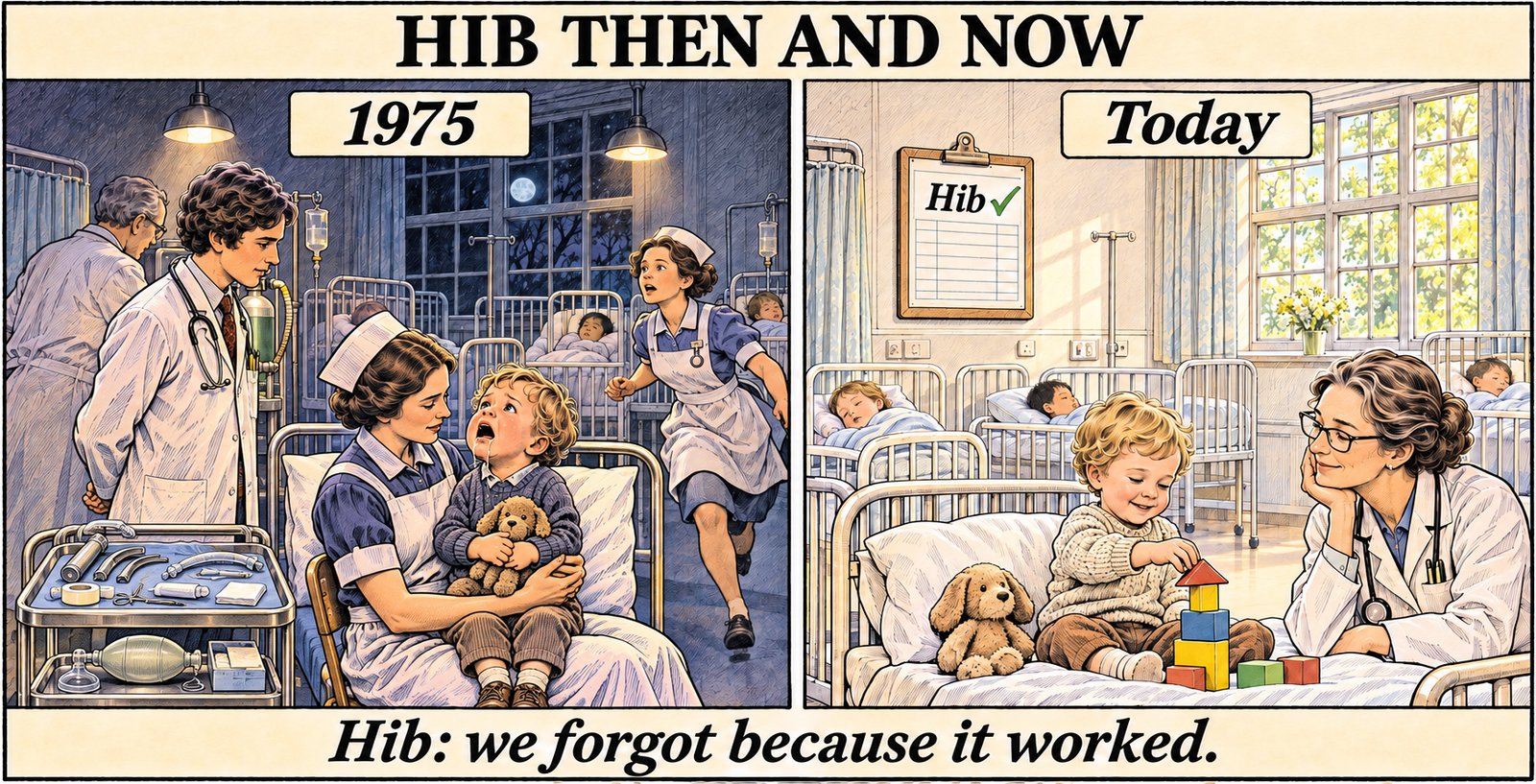
I started seeing children with meningitis as a Wayne State medical student at Children's Hospital of Michigan in 1968, before Hib vaccine existed. The viral cases had headaches and stiff necks and went home. The bacterial cases were different: pus at the lumbar puncture, seizures, fluid over the brain, empyemas, children who went deaf, children who died. Hib didn't stop at the meninges, either. I saw toddlers with epiglottitis, sitting bolt upright and drooling, and I intubated many of them myself before the swelling could close off their airway. Catching it in time was everything. I also saw children with swollen, purple eyelids from periorbital cellulitis, and children with hot, septic joints. Once Hib vaccine came in, all of those nearly disappeared from our wards.
In May 1974, as a Sick Kids resident posted to the Sioux Lookout Indian Hospital, I did the spinal tap myself on a boy of about six with pneumococcal meningitis. He died on the float-plane transfer as it landed at Dryden, with me the only caregiver aboard. I have never forgotten what that spinal fluid looked like. It was not clear.
No paediatrician who has seen pus on a lumbar puncture would accept a "viral" explanation for pus on a brain. — T.P.
What the meningitis experts say
These are the clinicians, researchers and bodies whose work bears directly on the questions the defence raised.
How the courts left it
- 26 April 2016 — Jury convicts David and Collet Stephan at the first trial. Dr. Sauvageau had testified for the defence there too, presenting a report arguing for viral meningitis.14
- 24 June 2016 — Justice Rodney Jerke sentences David Stephan to four months in jail and Collet Stephan to three months of round-the-clock house arrest, finding that "any reasonable and prudent person would have taken action" (R v Stephan, 2016 ABQB 353).41,42
- May 2018 — Supreme Court of Canada orders a new trial, finding the jury had not been properly instructed.31
- 19 September 2019 — Justice Clackson acquits. He accepts Sauvageau's viral/hypoxia theory and rejects Adeagbo, whose Nigerian accent he criticized in his written reasons.2,27
- 8 March 2021 — Alberta Court of Appeal overturns the acquittal for reasonable apprehension of bias over Clackson's comments about the Crown's medical expert. It also finds he improperly let David Stephan cross-examine Adeagbo for four days. A third trial is ordered (R v Stephan, 2021 ABCA 82).28
- June 2021 — The Crown stays the charges rather than proceed to a third trial.29
- Later — The Supreme Court of Canada declines to hear the Stephans' appeal of the third-trial order. Buckley said his clients no longer faced any charges.30
The finding that should not stand unchallenged
The only court finding that Ezekiel had "viral" meningitis came from a decision the Court of Appeal set aside for apprehension of bias. No court ever ruled on the medicine again, because the Crown stayed the charges. That has left a gap in the public record, and the Stephans' supporters have filled it with the claim that "the courts found he didn't have bacterial meningitis." They didn't. A judge whose decision was overturned said so. The pathology never changed: pus on the brain, pus in the chest, an unvaccinated toddler, and a disease that a vaccine prevents.
Sources
- Lethbridge News Now, "Defense lawyer presents closing arguments in Stephan trial," Aug 2019. lethbridgenewsnow.com/?p=409595
- Lethbridge News Now, Crown appeal hearing, quoting Justice Clackson's reasons. lethbridgenewsnow.com/?p=459783
- Lethbridge News Now, "Doctors disagree on cause of Ezekiel Stephan's death," 27 Aug 2019. lethbridgenewsnow.com/?p=409406
- Global News, "Autopsy confirmed 18-month-old Alberta boy died of meningitis, medical examiner testifies," 10 Mar 2016. globalnews.ca
- Red Deer Advocate / Canadian Press, "Medical examiner tells couple's trial that child died of bacterial meningitis," June 2019. reddeeradvocate.com
- Sumy State University, infectious diseases course text, "Meningitis." PDF; MIMER Medical College, Dept. of Pathology, "Meningitis." PDF
- Pathology teaching notes on CNS infections (gross pathology and CSF comparison). academe-pathology; meningitis overview. bohrium.com
- Yang L, Zhu Y, Wu G. "Intrapleural injection of urokinase in the treatment of acute Haemophilus influenza empyema in children." Frontiers in Pediatrics 2022;10. doi:10.3389/fped.2022.882005
- "Pleural empyemas in children due to Hemophilus influenzae." Bol Med Hosp Infant Mex 1979;36(4):665-77. MEDLINE abstract
- Peltola H, Pelkonen T, et al. "Vaccine-Induced Waning of Haemophilus influenzae Empyema and Meningitis, Angola." Emerging Infectious Diseases 2014;20(11). cdc.gov/eid
- CDC, Manual for the Surveillance of Vaccine-Preventable Diseases, Ch. 2: Hib (archived). archive
- D. Gorski, "Justice Clackson and his miscarriage of justice," Respectful Insolence, 7 Oct 2019 link; "The Crown appeals…," 16 Oct 2019 link
- Lethbridge News Now / Canadian Press, "Angry exchanges at trial…," 12 June 2019. lethbridgenewsnow.com/?p=397732
- CBC News, "Meningitis trial hears former chief medical examiner dispute toddler's cause of death," 20 Apr 2016. cbc.ca
- Global News, "Timeline of Ezekiel Stephan's final days." globalnews.ca
- Global News, "'Very sick little boy': pediatrician testifies…," Mar 2016. globalnews.ca
- Lethbridge News Now / Canadian Press, June 2019 (Adeagbo: no indication of oxygen deprivation). lethbridgenewsnow.com/?p=397627
- Lethbridge News Now, "Paediatric Specialist Testifies in Trial of David and Collet Stephan." lethbridgenewsnow.com/?p=235204
- Global News, "Pediatric doctor takes stand in retrial of David and Collet Stephan," 13 June 2019. globalnews.ca
- CFJC Today / Canadian Press, "Judge won't dismiss charges against Alberta couple…," 22 June 2019. cfjctoday.com
- CBC News, Lethbridge trial testimony of L. Vataman and T. Meynders, 10 Mar 2016. cbc.ca
- Global News, "Naturopath said she told Alberta couple to take toddler to hospital," June 2019. globalnews.ca
- Le Saux N, Canadian Paediatric Society, "Guidelines for the management of suspected and confirmed bacterial meningitis in Canadian children older than 2 months of age," posted 19 Oct 2020. cps.ca
- Children's Hospital of Philadelphia, Vaccine Education Center, "Hib." chop.edu
- Global News, 13 June 2019 (Burkholder: strongly suspected bacterial meningitis early on). globalnews.ca
- Science-Based Medicine, "The verdict is in: There is no justice for Ezekiel Stephan," Sept 2019. sciencebasedmedicine.org
- CBC News, "Justice Terry Clackson… complaint," Sept 2019. cbc.ca
- Calgary Herald, "Acquittal of Stephan couple overturned," 9 Mar 2021. pressreader; Global News, 8 Mar 2021. globalnews.ca
- Global News, "Alberta Crown stays charges against David and Collet Stephan," 23 June 2021. globalnews.ca
- The Globe and Mail / Canadian Press, "Supreme Court won't hear appeal by parents who have faced two trials in son's death." syndicated copy
- Lethbridge News Now, "CT scan of toddler's brain one of the 'most devastating' PICU Dr. had ever seen," June 2019. lethbridgenewsnow.com/?p=397963
- Public Health Agency of Canada, "Haemophilus influenzae type b" (archived 2006). archive
- Government of Canada, "Haemophilus influenzae disease: For health professionals," Figure 1, 1979–2012. canada.ca
- Canada Communicable Disease Report 2014;40(17):365–368. PMC5864475
- Bettinger J, Scheifele D, Le Saux N, et al. "Invasive Pneumococcal Disease in Canadian Children, 2000–2014: IMPACT." Paediatrics & Child Health 2016;21(Suppl 5):e59. academic.oup.com
- Alberta invasive pneumococcal disease before and after PCV7, 2000–2006. abstract
- "The epidemiology of invasive meningococcal disease and immunization programs in Canada" (review, 1940 onward). PMC6899262
- Government of Canada, "Invasive Meningococcal Disease: For health professionals." canada.ca
- R v Stephan, 2019 ABQB 715, Reasons for Decision of the Honourable Mr. Justice T.D. Clackson, Court of Queen's Bench of Alberta, 19 September 2019 (paragraph numbers as cited). Posted on CanLII Connects: canliiconnects.org/fr/commentaires/62064
- "Nontypeable Haemophilus influenzae Otitis Media: Mastoiditis and Meningitis Complicated with Central Venous Thrombosis in an Immunocompetent Child." PMC8111853
- R v Stephan, 2016 ABQB 353, Court of Queen's Bench of Alberta (Jerke J.). canlii.org
- The Globe and Mail / Canadian Press, "Father gets jail in son's meningitis death, mom gets house arrest," 24 June 2016. theglobeandmail.com
This page discusses evidence given in open court and published medical literature. It is commentary on a matter of public health interest and is not medical or legal advice.